Go Back Up

THE SYSTEM · DOMAIN STRUCTURE

The Five Enterprise Domains

The permanent domains within which enterprise activity, coordination, and value formation occur—and the interdependencies through which enterprise conditions take shape across them.

WHAT THE DOMAINS ARE

The five permanent domains of enterprise behavior


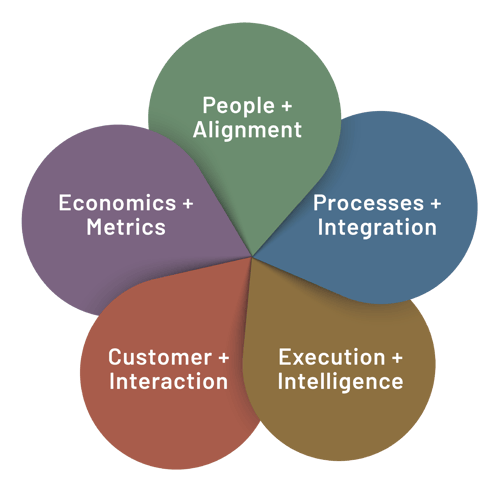
The Five Enterprise Domains™ identify the permanent structural domains within which enterprise behavior occurs. The domains are People + Alignment, Processes + Integration, Execution + Intelligence, Customer + Interaction, and Economics + Metrics. Together they account for where enterprise activity, coordination, and value formation actually take shape inside the organization.

The domains are not categories of activity, functional areas, or organizational divisions. They are the structural conditions through which any enterprise activity—however that activity is organized in the org chart—is conducted, observed, and produces consequences over time. People + Alignment is not the human resources function; it is the domain through which human capacity, intent, and coordination are organized. Customer + Interaction is not the marketing or sales function; it is the domain through which the enterprise's relationship with the market takes shape.

The domains are permanent in the sense that no enterprise operates outside them. Every organization, regardless of industry, size, or governance structure, operates within all five domains simultaneously. Enterprise conditions present within and across these domains, and the structural reading of an enterprise begins with locating which domains are producing which conditions.

chuck-teel-cpa-five-enterprise-domains-enterprise-science

THE FIVE DOMAINS IN DEPTH

Each domain in structural detail


Each of the Five Enterprise Domains is described below at the structural level. The book The Five Enterprise Domainstreats each domain in chapter-length depth; this page provides the reference summary for the system's interpretive vocabulary.

01

People + Alignment

The domain through which human capacity, intent, and coordination are organized inside the enterprise. People + Alignment surfaces conditions related to who is responsible for what, how individuals understand their accountability, how shared understanding develops or fails to develop across the organization, and how leadership posture shapes the enterprise's coordinated behavior. The domain is not synonymous with human resources; it operates above and around HR, talent management, and culture as the structural condition that makes those functions operate as they do.

02

Processes + Integration

The domain through which work is structured, sequenced, and integrated across the enterprise. Processes + Integration surfaces conditions related to how work flows between functions, where coordination interfaces are concentrated, where rework and delay accumulate, and how the design of work either supports or constrains the execution of strategy. The domain is not synonymous with operations or workflow; it operates above process design as the structural condition that determines whether processes themselves cohere across the enterprise.

03

Execution + Intelligence

The domain through which the enterprise observes its own operating conditions and adjusts its execution in response. Execution + Intelligence surfaces conditions related to how decisions propagate through the organization, how learning is retained or lost across execution cycles, how the enterprise reads signals from its own behavior, and how disciplined execution is governed over time. The domain is not synonymous with execution itself; it is the structural condition that determines whether execution is intelligent or merely active.

04

Customer + Interaction

The domain through which the enterprise's relationship with the market is structurally organized. Customer + Interaction surfaces conditions related to how customer relationships are initiated and sustained, how value propositions are operationalized in actual customer engagement, how feedback from the market is interpreted and integrated, and how the enterprise's external posture aligns with its internal capability. The domain is not synonymous with marketing, sales, or customer service; it is the structural condition that determines whether those functions deliver on the enterprise's stated relationship with the market.

05

Economics + Metrics

The domain through which enterprise value is structured, measured, and interpreted. Economics + Metrics surfaces conditions related to how financial outcomes are produced by operational decisions, how measurement systems either reveal or obscure the conditions that shape outcomes, how economic constraints propagate through the organization, and how the enterprise translates between operational reality and financial reporting. The domain is not synonymous with finance or accounting; it is the structural condition that determines whether financial reporting reflects operational reality.

“The domains are the geography of enterprise behavior. Conditions originate in one, surface in another, and consequence in a third. Reading any one in isolation produces an incomplete enterprise.”
Enterprise Science Inc.

HOW THE DOMAINS INTERACT

Interdependence is the structural mechanism


The Five Enterprise Domains do not operate independently. Each domain is shaped by the others, and the conditions that present within one domain often originate in another. People + Alignment shapes how Processes + Integration is operationalized. Processes + Integration determines how Execution + Intelligence is constrained or supported. Execution + Intelligence shapes how Customer + Interaction is sustained. Customer + Interaction determines how Economics + Metrics translates external reality into internal measurement. Economics + Metrics, in turn, shapes how People + Alignment is structured to deliver against measurable outcomes.

The interdependence is not linear. It is structural and recursive. A condition in Economics + Metrics—a measurement that obscures rather than reveals—can produce conditions in Execution + Intelligence (decisions made on incomplete signals), which produce conditions in Processes + Integration (work designed to satisfy measurement rather than to produce outcomes), which produce conditions in People + Alignment (people aligned to measurement rather than to enterprise reality). Reading any single domain in isolation will produce an incomplete diagnosis.

Conditions also present across domains. A coordination failure may surface as a Processes + Integration condition (interface design) but originate in People + Alignment (unclear accountability) and produce consequences in Customer + Interaction (inconsistent customer experience) and Economics + Metrics (margin compression). Locating where a condition originates, where it surfaces, and where it consequences is part of structural reading.

This is the structural argument for why the Five Enterprise Domains operate as one system rather than five independent categories. Conditions cannot be reliably interpreted within a single domain because their origins and consequences extend across the structure. The domains are the geography within which interpretation occurs, and interpretation requires the full geography.


HOW CONDITIONS PRESENT

Reading the signals enterprises emit


Enterprises emit signals of their structural condition continuously. Some signals are observable in financial outcomes—margin movement, revenue concentration, working capital behavior. Others present in operational metrics—cycle time, defect rates, completion variance. Still others appear in qualitative form—how meetings are run, what gets escalated, where decisions accumulate, how leaders describe their own organization. The Five Enterprise Domains provide the structural framework for interpreting these signals as evidence of underlying conditions.

The book The Five Enterprise Domains documents 120 enterprise signals across 28 categories, each tied to specific domain combinations. The signal tables enable disciplined reading—identifying which signals indicate which conditions, where conditions are likely originating, and where consequences are likely to emerge. This is the operational dimension of the system: the translation from observation to interpretation.

Reading conditions is a sustained discipline rather than a discrete diagnostic. Enterprise behavior is observed over time—weeks, months, quarters—and patterns emerge through accumulated observation rather than from any single reading. The Operational Appendix System in the book provides instruments for sustained observation: the Weekly Signal Scan, the Monthly Interface Review, the Quarterly Coherence Conversation. These instruments are how the structural reading of an enterprise becomes a continuing practice rather than an event.

WHERE TO READ MORE

Continued reading on the domain structure


The treatment on this page is the institutional reference summary. The full chapter-length development of each domain—including signal tables, leadership pattern documentation, and the Operational Appendix System—is in the book The Five Enterprise Domains.

Publication

The Five Enterprise Domains

The structural reference work. 454 pages. 122 original diagrams and tables. 120 enterprise signals across 28 categories. Activity Blueprint™ samples across industries and revenue ranges. Available June 1, 2026.

About the Book →
Adjacent Module

Activity Architecture™

The system module that examines how work is structured across people, processes, and interfaces inside the domains. Activity Architecture and Activity Blueprint together form the structural reading instrument for the Five Enterprise Domains.

The System →

CONTINUE INTO THE SYSTEM

Two further dimensions of the system

 
This page describes the domain structure of Enterprise Science. The two pages below describe what Enterprise Science is at the system level and how the system is used in institutional practice over time.

/system/system-overview

Enterprise Science System Overview

The institutional articulation of what Enterprise Science is, how it is grounded, and what distinguishes it from frameworks, methodologies, and consulting offerings.

System Overview →
/system/how-to-use

How the System Is Used

The operational shape of recurring application—access, classes of use, the interpretive cadence, and the institutional context in which the system operates over time.

How to Use →

INQUIRY

Direct inquiry

Licensing, certification, partnership, and publications inquiries are handled through the Contact form, routed by subject to the governance process responsible.

Trademark Usage: Enterprise Science™ is a trademark identifying business consulting and education services offered on this page. Five Enterprise Domains™, Activity Architecture™, and Activity Blueprint™ are trademarks identifying business consulting modules, methodology, educational modules, instructional content, and educational tool and instructional materials offered on this page. Enterprise Science™ and the module marks above are trademarks of Charles W. Teel Jr., CPA, LLC, used under license by Enterprise Science Inc. © 2025-2026 Enterprise Science Inc. All rights reserved.